If your organization files an Integrated Annual Report (Memoria Anual Integrada) with Chile’s Financial Market Commission (CMF), this applies to you. General Rule (Norma de Carácter General, NCG) No. 519 adopts the IFRS S1 and S2 standards from the 2026 financial year, which is reported in 2027.
This is not voluntary. It is mandatory.
NIIF S1/S2 = IFRS S1/S2, issued by the ISSB. NIIF is the Spanish name, and the one Chilean regulation uses.
IFRS: International Financial Reporting Standards.
NIIF: Normas Internacionales de Información Financiera.
What NCG 519 is.
Sustainability moves into financial language, with the same demand for rigor.
The rule does not start from zero. NCG No. 519 amends NCG No. 461, which stays in force, to bring in two international standards:
- IFRS S1: sustainability risks and opportunities that are material to the business.
- Example: a bank that finances projects exposed to deforestation or ecosystem degradation must state how that could turn into credit and reputational risk across its loan book.
- IFRS S2: physical climate risks (drought, wildfire) and transition risks (regulatory, market).
- Example: a mining company in a water-stressed area must report how water availability exposes its operation and its projects.
Both follow the four pillars of the TCFD: Governance, Strategy, Risk Management, and Metrics and Targets.
Who it applies to, and when.
Report in 2027 on the 2026 financial year, with a way out for the smallest.
Regulatory status decides it, whatever your industry: it applies if you are an issuer of publicly offered securities registered with the CMF and you file an Integrated Annual Report. In practice, that covers sectors such as:
- Banking and financial services
- Insurance
- Mining
- Forestry and agribusiness
- Energy and utilities
- Retail and consumer goods
The deferred provisions come into force on 31 December 2026, with the option of early adoption. Entities with average consolidated assets below one million UF (Chile’s inflation-indexed unit of account) are exempt from the full integrated report.
You must state whether there was third-party assurance: what information was verified, and under which standard. The rule encourages assurance without requiring it, and the market is moving fast towards auditable data.
The real challenge comes earlier.
Understanding the rule is easy. Producing the evidence is hard.
IFRS S2 requires you to describe physical risks to your real assets: water, wildfire, the condition of the ecosystems around your operations. That information rarely exists in a consistent, verifiable format. It lives scattered across one-off consultancy studies and spreadsheets that do not talk to each other.
An example of the problem: you close the financial year in December 2026. The risk data you did not gather in time simply does not appear in your report. The clock is already running.
Where Lemu comes in.
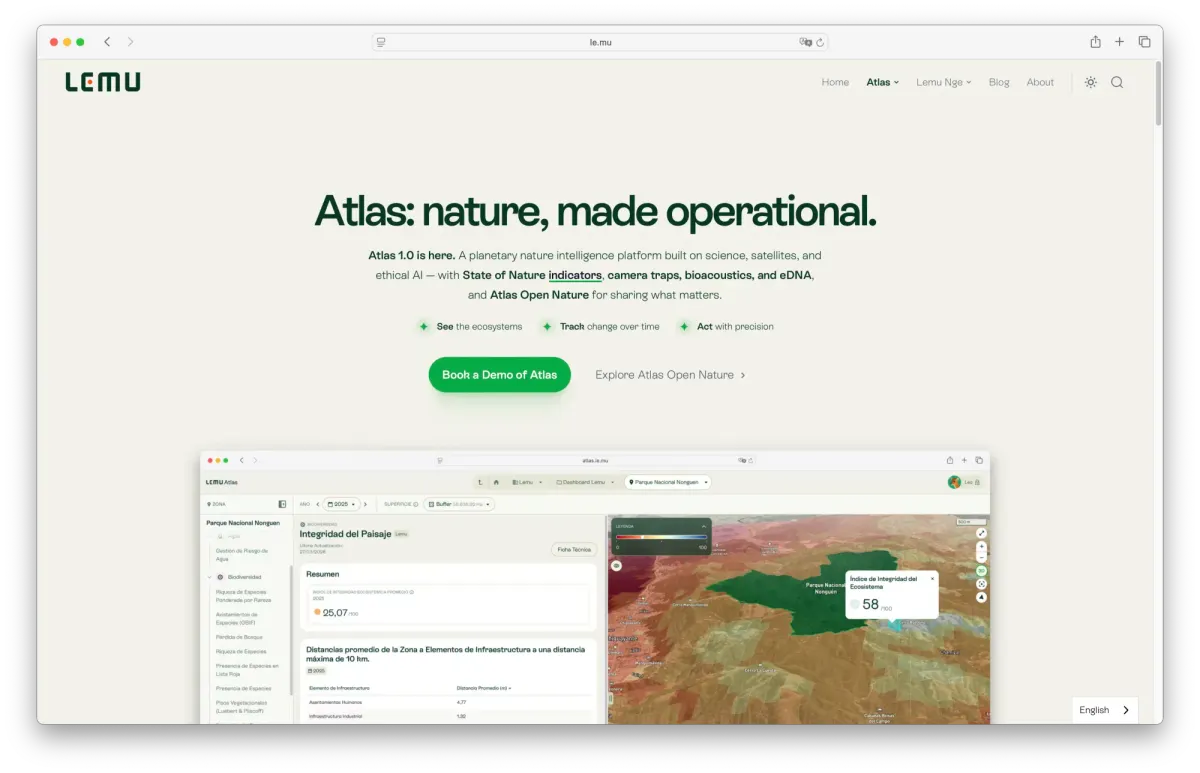
The rule defines what to report; Atlas gives you the evidence to back it up.
Atlas turns satellite, ecological and territorial signals into indicators with documented provenance: where each data point comes from and how it was derived. The fit is direct. IFRS S1/S2 call for exactly the kind of evidence Atlas produces: watershed water risk, vegetation cover, habitat loss. These are the indicators the standards inherit from the TCFD, and that the TNFD (the nature framework) takes further still.
For your NCG 519 report, that means physical-risk indicators: water, wildfire, ecosystem condition and extent, forest loss, for the zones where you actually operate, ready to support your IFRS S2 disclosures, without changing the tools you already use.
NCG 461 also requires each industry’s SASB metrics. Atlas contributes there too: watershed water-stress context, land-use risks (nearby populations, proximity to protected areas), deforestation detection, and the presence of threatened species or of species on the Red List.
We do not replace your sustainability team or your auditor. We give them the evidence base that is missing today.
 Lemu
Chile adopts a global standard.
NCG 519 is the Chilean version of a need that has already crossed four continents.
Far from a local oddity, NCG 519 is Chile’s gateway into one global standard, the ISSB’s IFRS S1/S2, which different countries are adopting under their own names and regulators:
- Mexico: the CNBV implemented IFRS S1/S2; the first mandatory report was in 2026, with data from the 2025 financial year.
- Brazil: the CVM is moving towards disclosures aligned with the ISSB for listed companies, with phased implementation.
- European Union: the CSRD uses its own framework (ESRS, with double materiality), designed to be interoperable with the ISSB.
- United Kingdom: the UK SRS S1/S2, based on IFRS, are already published (February 2026); S2 becomes mandatory for listed companies in 2027.
- Many more: Colombia, Australia, Japan, Canada and others are moving in the same direction.
By January 2026, 21 jurisdictions had already adopted these standards, on a voluntary or mandatory basis, and a dozen more are preparing to follow (S&P Global).
The underlying reading is simple: if you operate or raise capital in more than one market, this requirement will follow you. Solving the data problem once, and well, solves it everywhere.
The underlying shift.
In Chile, environmental information now carries the same weight as financial information. Those who reach 2027 with solid data will comply, and they will also hold a real advantage with investors who demand comparable transparency.
The question is whether you will arrive with defensible data, or improvising.
Want to see the physical-risk indicators for your own operations?